
How AI Improves Supplier Risk Management
11-Sep-26
Modern supply chains stretch across dozens of countries and regulatory regimes, and across several supplier tiers, and keeping track of supplier stability across all of them has outgrown manual review cycles. AI in supplier risk management gives procurement and risk teams a way to catch financial distress, compliance gaps, and weak operational points before they turn into disruptions. The shift is away from periodic snapshots and toward ongoing visibility, with faster, more precise responses when something changes.
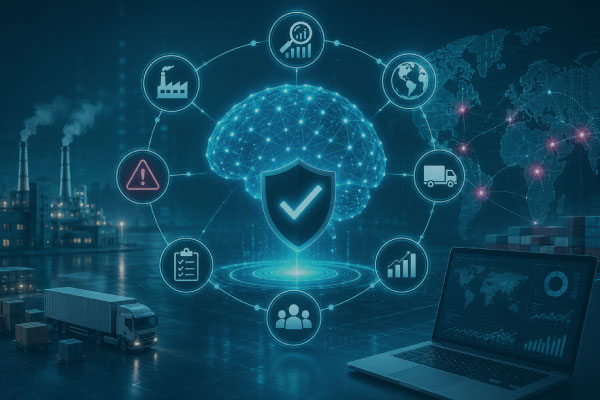
At its core, AI in supplier risk management uses machine learning, natural language processing, and predictive analytics to evaluate a supplier's financial, operational, and compliance standing on an ongoing basis. Where older approaches relied on annual audits or static questionnaires, AI systems pull from financial filings, news coverage, regulatory databases, and trade payment records to build a current picture of risk.
The practical difference shows up in what gets caught. A model trained on historical patterns can pick up on subtler signals, such as a slowdown in payment cycles or an unusual spike in litigation mentions, that would likely slip past a reviewer working through a checklist once a year.
A single vendor's problems rarely stay isolated. A supplier's default, a factory shutdown, or a regulatory breach several tiers down the chain can stall production, strain customer relationships, and create legal or reputational fallout for everyone connected to it. Procurement and risk leaders are now expected to prove not just that due diligence happened once, but that it continues.
Regulatory expectations have shifted too, though not uniformly in one direction. In the EU, the Omnibus I package (Directive (EU) 2026/470), in force since 18 March 2026, narrowed the Corporate Sustainability Due Diligence Directive: fewer companies fall in scope, and the required review of due diligence effectiveness moved from at least every 12 months to at least every five years. Germany has followed a similar path with its own Supply Chain Act. What has not changed is the obligation to act without undue delay when a significant change occurs or when existing measures look inadequate, and noticing that change is a monitoring problem. Customers and investors also continue to expect evidence of oversight regardless of what the statutory minimum requires.
Conventional supplier reviews tend to be periodic and narrow, often limited to a handful of financial ratios checked once or twice a year. AI in supplier risk management changes that by pulling together a wider set of signals at once: payment behaviour, ownership changes, adverse media, sanctions updates, and more, and watching them continuously rather than in isolated snapshots.
The value comes from looking at these signals together rather than one at a time. A payment delay alone might mean little, but paired with a leadership change and a negative news mention, it can point to risk building well before it shows up in a financial statement. That earlier signal gives risk teams room to plan, whether that means opening a conversation with the supplier or lining up a backup source.
Financial distress detection: Spotting early indicators such as delayed payments or irregular filing patterns, alongside credit downgrades, which tend to confirm distress rather than preceding it.
Sanctions and watchlist screening: Checking suppliers and their beneficial owners where ownership data is available, against global regulatory lists on an ongoing basis.
Adverse media monitoring: Scanning news and public records for litigation, environmental violations, or labour disputes tied to a supplier.
Supply chain mapping: Surfacing sub-tier suppliers and concentration risk that direct contracts alone don't reveal.
ESG and compliance tracking: Screening supplier disclosures and public records for reported gaps against environmental and labour standards.
Supply chain mapping in particular pushes risk visibility past the first tier of direct suppliers and into the wider network behind them, while the other applications add depth on suppliers already identified.
The most immediate gain is speed. Automated monitoring closes the lag that comes with manual review cycles, so risk teams learn about problems as they surface rather than at the next scheduled audit. Scoring also becomes more consistent, since a model applies the same criteria to every supplier rather than leaving outcomes to depend on which reviewer handled the file.
There's a resourcing benefit too. Teams can direct their attention to suppliers actually flagged as high-risk instead of working through the entire vendor list on a fixed schedule, which tends to improve both the speed and the quality of decisions across the supplier relationship.
The next stage of development is likely to bring in data that today's models mostly leave out: climate risk indicators, geopolitical developments, logistics and shipping disruptions. Predictive capabilities should also extend further upstream, giving visibility into risks that originate several tiers removed from a company's direct suppliers.
Closer integration with procurement platforms is another likely direction, where risk scores feed directly into sourcing decisions and contract terms rather than sitting in a separate compliance report that gets checked after the fact.
Everything starts with data quality. A model is only as useful as the data behind it, so verified and well-structured supplier information matters more than the sophistication of the algorithm itself. Clear risk thresholds and escalation paths matter just as much, since an alert that no one acts on doesn't reduce risk.
Getting procurement, compliance, and risk teams working from the same output also helps, since AI flags are only useful if they're interpreted consistently across functions. Models need periodic review too, so that what counts as a risk indicator keeps pace with new regulations and shifting business priorities.
Checking suppliers once a year no longer matches the pace at which risk actually develops. Continuous, data-driven oversight is now a practical baseline for protecting operations and for catching the significant changes that due diligence obligations still require organisations to act on. With verified business data and ongoing monitoring, Dun & Bradstreet helps organisations stay ahead of supplier risk and make sourcing decisions with more confidence.
A. AI analyzes large volumes of supplier data to identify potential risks, predict disruptions, and support proactive decision-making.
A. AI can help identify financial, operational, compliance, cybersecurity, and supply chain risks.
A. Yes, AI continuously monitors data sources and alerts businesses to emerging risks as they arise.
A. By combining data from multiple sources, AI delivers faster, more accurate risk evaluations than manual processes.
A. AI helps reduce disruptions, improve supply chain resilience, enhance compliance, and support informed sourcing decisions.

Dun & Bradstreet India
Dun & Bradstreet, the leading global provider of B2B data, insights and AI-driven platforms, helps organizations around the world grow and thrive. Dun & Bradstreet’s Data Cloud, which comprises of 455M+ records, fuels solutions and delivers insights that empower customers to grow revenue, increase margins, build stronger relationships, and help stay compliant – even in changing times.


 Contact us