
Green Economy: What is Green Economy and Its Meaning?
24-Feb-26
Green Economy ceases to be a sustainability story. It is a model of strategic growth that is transforming the capital flows, regulations, and competitive advantage. With climate policy becoming stricter, and green investment gaining increased momentum, the questions that are becoming more acute among the leaders are: what is green economy, where is the value being created responsibly, and which of the players are being credible in the transition? Let's explore.
In assessing credibility during this transition, many organisations now rely on structured credibility reports and risk insights from Dun & Bradstreet to evaluate financial strength and ESG alignment.
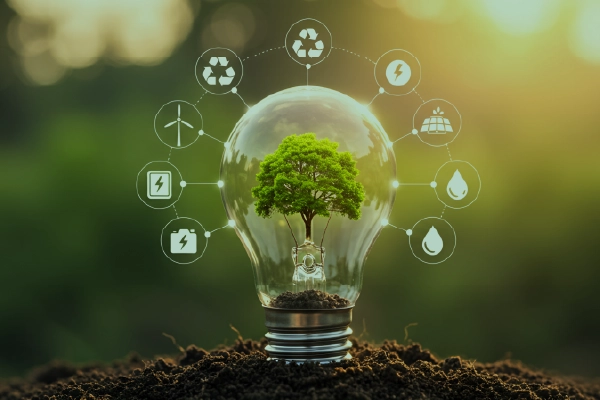
The Green Economy meaning is basically an economic model where economic growth, human wellbeing, and social equity are in balance with environmental health. It focuses on the low-carbon development, resource efficiency, and social inclusion- lessening environmental risks and encouraging sustainable prosperity and employment. In this model, clean technology investment, renewable energy, and sustainable infrastructure lead to economic and ecological benefits.
A green economy, unlike the traditional models in growth-based theories, entails achieving economic growth without compromising natural systems and social welfare. To support this shift, businesses increasingly use intelligence platforms such as D&B Hoovers to identify sustainable companies and assess green market exposure.
The Green Economy is rooted in values that put growth in line with social goodwill, environmental capacities, and social responsibility.
The economic development is quantified by changes in human well-being, not only in GDP growth. This principle is based on a health priority, livelihoods, access to basic services, and quality of life. In a green economy, clean energy and resilient infrastructure investments, sustainable cities are developed to provide concrete social benefits, which guarantee that growth will enhance living standards, and social and environmental costs will be minimised in the long term.
A green transition should be just and accommodating. The justice principle makes sure that the advantages and costs of economic change are evenly spread among communities, workers, and regions. It focuses on the security of vulnerable populations, allowing displaced workers to be reskilled, and providing access to green opportunities, thus sustainability does not become the prerogative of a few.
This principle acknowledges the fact that economic activity has to operate within the ecological boundaries. It balances the growth plans with the ability of the planet to absorb the emissions, replenish the resources, and support the biodiversity. Incorporating environmental thresholds into the decision-making process, organisations and policymakers can prevent the existence of growth models that will bring short-term gains at the long-term price of irreparable ecological devastation.
Sustainable growth means doing more with less--and when enough is enough. The principle encourages efficient resource use, circular design, and responsible patterns of consumption. It opposes the wasteful models of production and promotes innovation, which is less material-intensive, low-energy-intensive, and low emissions, as well as achieves economic value and competitive advantage, often supported by insights from reliable B2B database providers that help evaluate compliant and resource-efficient suppliers.
Green transitions require well-established institutions, clear regulation, and responsible leadership. The principle of good governance focuses on the coherence of the policies, ethical conduct of business, and the application of environmental and social standards. It provides the environment of trust, making sure that green promises have a concrete outcome and do not constitute reputational signalling, with independent credibility reports strengthening transparency and accountability.
Green economy is turning out to be a strategic requirement rather than a policy choice. With climate risk redefining regulation, capital allocation, and supply chains, organisations not adapting meet the effects of increasing compliance costs, alienated assets, and diminished competitiveness.
In addition to reducing risks, the green economy enhances energy security, stabilises the supply of resources, and increases long-term economic resilience. In the case of businesses, it transforms sustainability as an expense centre to a driver of growth, where regulatory preparedness, ESG plausibility, and future-fit operations become a determinant of market access and investor confidence.
The green economy is quickly transforming into a multi-trillion-dollar growth front. In the modern world, green revenues worldwide are more than $5 trillion every year and are expected to increase by more than $7 trillion by 2030 to outpace more traditional sectors in their growth and investment pace.
This growth provides wide business prospects in the domain of renewable energy, sustainable infrastructure, clean mobility, circular technologies, and green finance. Renewable energy means employment increased to more than 16 million jobs worldwide in 2023, due to scaling requirements and job changes.
Governments, investors, and corporations are pouring in more capital than ever into the low-carbon solutions and sustainability is becoming both a risk requirement and a revenue generation tool to organisations that can find the high-growth opportunities, partners that they can trust, and value chains that are compliant.
Green economy and circular economy are two different frameworks that are complementary.
A green economy is a generalised form of economy that is concentrated on low-carbon development, environmental security, and social integration. It touches on such areas as renewable energy, green finance, sustainable infrastructure, and climate policy, forming the way whole economies develop and mitigating environmental risk.
The circular economy is a system of work whose model centres on the flow of resources in the production and consumption processes. It focuses on waste reduction, keeping products' life cycles long, reuse of materials, and designing out pollution through circular design and closed-loop systems.
Green economy has systemic opportunities, but implementation is limited due to structural and operational impediments.
Divergent policies and shifting standards add to the compliance expense and retard the international implementation.
The green infrastructure and clean technologies are long-term investments whose payback periods are uncertain.
A lack of visibility of the supplier practices increases compliance risk, reputational risk, and greenwashing.
Lack of green skills and transition expertise decelerates adoption and scale.
It is a matter of matching capital, policy, and plausible implementation; without governance and data transparency, green ambition will not transform into sustainable growth.
Senior Director, Analytics and Business Advisory
Dun & Bradstreet India
Dun & Bradstreet, the leading global provider of B2B data, insights and AI-driven platforms, helps organizations around the world grow and thrive. Dun & Bradstreet’s Data Cloud, which comprises of 455M+ records, fuels solutions and delivers insights that empower customers to grow revenue, increase margins, build stronger relationships, and help stay compliant – even in changing times.

Create a faster path from prospect to profitable relationship with D&B Hoovers. Get comprehensive USA & UK company information.

 Contact us