
What Are AI Connectors and Why Enterprises Need Them for Trusted
29-Oct-26
Artificial intelligence (AI) can process information and generate responses. However, its usefulness in an enterprise depends on how well it connects with the systems and data businesses already use. AI connectors bridge this gap. They let models and agents retrieve business data and interact with enterprise systems. However, the quality, security, and governance of these connections determine how much businesses can trust the results.
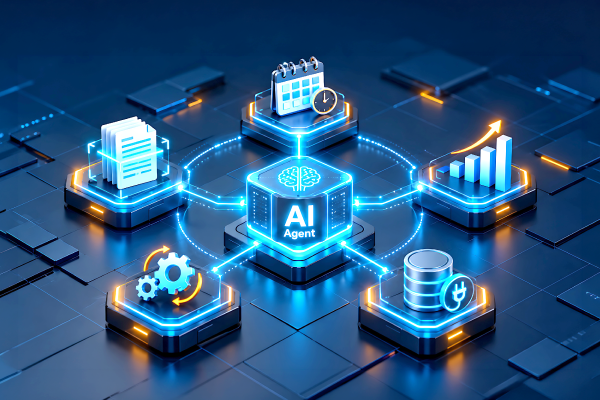
What are AI connectors, and why do they come up in nearly every enterprise AI plan? They are the integrations that link a model or agent to the systems where an organisation's information and actions live, such as a CRM or a document repository. A connector handles authentication, translates a request into the format a source understands, and returns results the model can use.
A user or agent asks a question, and the AI application decides which source can answer it. The connector authenticates with that user's permissions, queries the source and passes back the result with details such as origin and timestamp. The model then composes its answer from what came back. Some connectors only read, while others can write, for example by creating a ticket or updating a record. Standards are emerging here too: MCP is now a founding project of the Linux Foundation's Agentic AI Foundation, giving connectors a shared way to describe their tools.
Enterprise data sits in many places that rarely talk to each other. Salesforce's 2026 Connectivity Benchmark found the average organisation manages 957 applications, with only 27% of them connected. Data readiness is the related risk. Gartner predicts organisations will abandon 60% of AI projects unsupported by AI-ready data through 2026, and 63 percent of those surveyed either lacked suitable data management practices or were unsure. AI connectors are how prepared data actually reaches the model.
With AI connectors, answers draw on current records, not on a snapshot from training. Employees stop copying figures between systems by hand. Permissions carry through, so the model sees only what the person asking is allowed to see. A governed route into each source also replaces the scattered scripts that teams build on their own, and a reusable connector makes adding the next AI use case faster.
Four patterns account for most deployments:
Employees ask questions in plain language, and connectors query the wiki and shared drives at once. Permission-aware results with links back to the source let a reader check the answer instead of trusting it.
An assistant can pull account history and relevant knowledge articles, then draft a reply for an agent to approve. A write connector can log the outcome on the ticket, which keeps the record complete without extra effort.
Sales teams need internal CRM history alongside outside signals. D&B Hoovers supports company filters and trigger alerts, and connecting external signals of that kind to CRM records gives a representative background on an account before the first call.
Agents chain actions across systems. An agent might spot an invoice discrepancy, retrieve the purchase order from the ERP and draft a query to the supplier. This depends on write connectors, so approvals and limits matter.
Connectors differ by what they touch. Some reach structured sources such as databases and warehouses, while others handle unstructured material such as documents and email. They also differ by permission: read-only connectors retrieve information, and read-write connectors can change it. A third distinction is how they are built. Vendors supply managed connectors, teams write custom ones for internal systems, and protocol-based connectors follow a shared standard.
A connector is only as good as its source. When two systems disagree about a customer, AI gives a confident wrong answer. The D-U-N-S Number, Dun & Bradstreet’s unique business identifier, matches duplicate records to one company, and the Data Cloud enriches them with external data. The connector delivers the data, but its quality decides how far the answer can be trusted.
Agents act as well as answer, which turns connectors into a control point. A read-only connector limits harm, whereas a write connector lets an agent change real records. Gartner expects over 40% of agentic AI projects to be cancelled by the end of 2027, citing rising costs, unclear value and inadequate risk controls. Scoped permissions and approval steps on connectors answer the last of those concerns directly.
As organisations expand their AI deployments, managing multiple connectors introduces its own set of challenges.
Sprawl comes first, since every new source adds another integration to maintain. Permissions can drift, leaving a connector with wider access than the person using it should have. Source systems change their interfaces without notice, and stale data slips through when refreshes lag. Untrusted content in a connected source can also carry instructions meant to mislead the model.
Start small and widen access once the controls prove themselves.
Begin with the systems that support the highest-value decisions, such as the CRM or the contract repository. A few well-governed connectors usually deliver more than a broad rollout.
Pass the user's identity through to each source, apply least-privilege credentials and keep sensitive fields out of reach unless a use case requires them. Log which sources were queried for every answer.
Track freshness and error rates for every connector. Compare connector outputs with the source of record on a regular schedule, and retire connectors that nobody uses.
Require a person to approve any action that changes a financial record, contacts a customer or alters access. Low-risk reads can run freely.
AI connectors decide whether enterprise AI works from facts or from guesses. Organisations that govern them well and feed them reliable business data, such as the entity information Dun & Bradstreet maintains, give their AI a dependable footing. Trusted AI follows from that groundwork.
A. AI Connectors are integrations that allow AI systems to securely access data from business applications, databases, websites, and enterprise tools.
A. They enable AI to use real-time, business-specific data, resulting in more accurate and relevant insights.
A. By connecting AI to verified enterprise data sources, they reduce misinformation and help ensure reliable responses.
A. AI Connectors can connect with CRMs, ERPs, cloud storage platforms, databases, collaboration tools, and knowledge management systems.
A. They enhance productivity, improve decision-making, automate workflows, and help organizations scale AI securely across the business

Dun & Bradstreet India
Dun & Bradstreet, the leading global provider of B2B data, insights and AI-driven platforms, helps organizations around the world grow and thrive. Dun & Bradstreet’s Data Cloud, which comprises of 455M+ records, fuels solutions and delivers insights that empower customers to grow revenue, increase margins, build stronger relationships, and help stay compliant – even in changing times.

 Contact us