
What Are AI Connectors and Why Enterprises Need Them for Trusted
29-Oct-26
AI is only as useful as the tools and data it can reach. Connecting it to your company's systems used to mean building a custom link every single time. The Model Context Protocol (MCP) fixes that with one simple, shared way to plug AI into your data and tools. This guide explains how it works, how it differs from RAG, and how to use it safely at work.
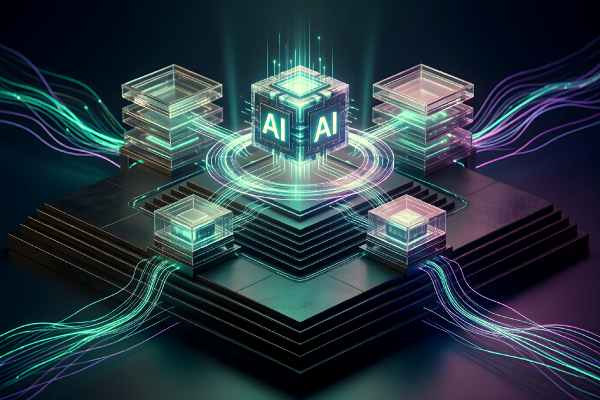
What is a model context protocol, and why are enterprises paying attention? MCP is an open protocol that standardises how language model applications connect to external data sources and tools. Before it, each integration between a model and a business system needed custom code. The protocol replaces that patchwork with a common interface, much as the Language Server Protocol did for programming-language support in development tools.
The Model Context Protocol uses JSON-RPC 2.0 messages to connect three components: a host that initiates the connection, a client that manages communication and a server that provides context and capabilities. Servers expose resources (data), prompts (templated workflows) and tools (executable functions). The protocol also supports version and capability discovery to ensure compatibility between clients and servers.
Three participants and a transport layer make up the architecture, and each has a distinct job.
The host is the AI application a person actually uses, such as a chat assistant or a coding environment. It initiates connections, decides which servers to trust and obtains user consent before exposing user data to servers or invoking tools.
A client is a connector inside the host. It speaks the protocol on the host's behalf, passing requests to a server and returning results to the model.
A server wraps a system such as a database or a business application, and presents it through resources, prompts and tools. Most of an enterprise's integration effort sits here.
The transport carries the messages. The specification defines two standard bindings: stdio, where a client launches a local subprocess, and Streamable HTTP, where each message is an HTTP POST to a single endpoint. Protocol meaning stays the same on both.
A shared protocol reduces duplicated integration work, because one server can serve many AI applications. It also limits lock-in: MCP has become a founding project of the Linux Foundation's Agentic AI Foundation, with Anthropic and OpenAI among its co-founders, so no single vendor controls its direction. Reported adoption supports the case: as of December 2025, the MCP project reported 10,000 active servers and over 97 million monthly SDK downloads. Central servers also give security teams one place to apply access rules.
Typical uses include an assistant that queries an internal knowledge base and a finance workflow that pulls figures from an ERP before drafting a summary. Reference data matters as much as connectivity. If an agent is asked about a supplier, the answer depends on whether the tool behind it resolves the name to one legal entity. A server backed by records keyed to the D-U-N-S Number, Dun & Bradstreet's identifier for a business entity, removes much of the guesswork between similarly named companies.
Retrieval-augmented generation fetches passages from an indexed knowledge base so a model can ground its answer. MCP is a connection standard, and it can do more than retrieve: a model can call tools that write data or trigger actions. The two are complementary. A RAG pipeline often sits behind an MCP server, which exposes retrieval as one tool among others.
The specification is direct about the risk. Tools represent arbitrary code execution, and tool descriptions should be treated as untrusted unless they come from a trusted server. It also admits that the protocol cannot enforce its own security principles, which leaves enforcement to implementers. Practical controls include least-privilege credentials, an approved list of servers, user consent before tool calls and audit logs of what was invoked. In April 2026, security researchers at OX Security reported more than 7,000 publicly exposed MCP servers affected by a flaw they traced to how the official SDKs launch local servers, although Anthropic described the behaviour as expected.
Start with a narrow use case, then widen access as controls prove themselves.
Pick the system that holds the most useful context, and expose only the operations a workflow needs. Read-only access is a sensible first step. Name tools and describe them precisely, because the model relies on those descriptions to choose between them.
Local servers over stdio suit individual developers, since the client launches the process on the same machine. Remote servers over Streamable HTTP suit shared enterprise services, where authentication, logging and central updates matter more than convenience.
The 2026-07-28 specification makes requests stateless and self-contained, and Streamable HTTP mirrors key metadata into headers so intermediaries can route traffic without reading the message body. That design lets teams run several server instances behind a load balancer, with standard monitoring around them.
Security is the first limitation, since a connected agent can act on what it reads, including instructions hidden in untrusted content. The specification itself has changed: the 2026-07-28 version replaced earlier session-based behaviour, and clients that need to work with older servers must detect them and fall back. Too many tools can also confuse a model, so curation counts. Finally, an agent is only as reliable as the data behind its tools. Trusted business data from providers such as Dun & Bradstreet gives agents a verified reference point when they handle supplier or credit questions.
The Model Context Protocol gives enterprises a common way to connect AI to the systems where work happens. Its value depends on disciplined deployment: narrow permissions, vetted servers and data that can be trusted. Organisations that pair the protocol with verified business information, such as Dun & Bradstreet's entity data, are better placed to let AI act on facts instead of guesses.
A. MCP is an open standard that enables AI models to securely connect with external data sources, business applications, and tools, allowing them to access real-time information and perform actions across enterprise systems.
A. MCP helps enterprises integrate AI with existing business systems such as CRM, ERP, databases, and knowledge repositories, improving accuracy, automation, and decision-making.
A. By providing structured access to relevant data and tools, MCP reduces hallucinations, enhances context awareness, and enables AI assistants to deliver more reliable responses.
A. Yes. MCP is designed with controlled access mechanisms, allowing organizations to define permissions, manage data access, and maintain governance over AI interactions.
A. MCP can be used for customer support automation, enterprise search, workflow orchestration, data analysis, AI-powered copilots, and connecting AI models to internal business applications.

Dun & Bradstreet India
Dun & Bradstreet, the leading global provider of B2B data, insights and AI-driven platforms, helps organizations around the world grow and thrive. Dun & Bradstreet’s Data Cloud, which comprises of 455M+ records, fuels solutions and delivers insights that empower customers to grow revenue, increase margins, build stronger relationships, and help stay compliant – even in changing times.


 Contact us